
What to Learn From China.
Chinese leaders have tried to sandblast away awkward chapters from their modern history. Here some parts Americans need to learn about—especially now.


This post is about three aspects of China’s modern history that Americans should pay more attention to—for our own good. Two of them are well-known Chinese (and American) success stories that Trump-era policy is ignoring. The third is a self-inflicted disaster in China with all too many similarities to the current MAGA path. All are being discussed non-stop in the China-hand crowd, but they should move more into mainstream attention. (This post is occasioned by Donald Trump’s talk this past week with Xi Jinping, and the increasing insanity of the US approach toward China.)
Donald Trump may not know any Chinese history, or any history at all.1 The people around him may not care. The rest of us can’t afford to ignore it.
Let’s start with the two clear success stories, now being reversed.
1) American higher-ed’s advantage: ‘Foreign-visa’ students.
The story of American higher education since World War II has surprising connections with the story of China’s re-opening through the past 45+ years.
What German universities were for international science through the 1800s, what British and French and Italian universities had been for world scholarship in the centuries before, is what US universities became over the past 80-plus years. The US emerged as the place where research funding was greatest, where discoveries and applications were most frequent and significant, where talent from around the world most wanted to congregate. In higher ed more than any other field, the US came to occupy the commanding heights—with enormous economic, cultural, and strategic benefits to Americans.
Among the important sources of that incoming talent was of course the vast, ambitious population of China, starting in the 1980s once the country began opening up. It’s easy to take the results for granted, but they are profound. In almost every remote corner of China where Deb and I have journeyed, we’ve run into a family with a cousin who’d studied at, say, Michigan State—or heard of a village’s star student who had gone to, say, Tulane and stayed to start a successful American business.
And nearly every college leader we’ve ever met in the United States has mentioned the crucial role of foreign students overall, and those from China in particular, in the intellectual success and financial survival of their schools. Of the 1.1 million foreigners who now have visas to study at US colleges and universities, about one-quarter are Chinese. Many more of them pay “full freight” than do US students—as every university administrator knows. (They don’t qualify for Pell grants, the GI Bill, and many other forms of support.) In “balance of trade” terms, US higher ed may be the most successful single segment of the entire economy.
You couldn’t think of a stupider or more history-blind step the US could now take than to choke off the flow of international students. But that is what the Trump visa-jihad boils down to—focused on Harvard, but spreading everywhere. Li Yuan of the New York Times, who first came to the US as a student from China, has laid out this balance in a lovely essay. Peter Hessler recently told a parallel story, about a Chinese student who might have to leave Harvard, in The New Yorker.
Every American with international contacts has heard similar accounts from friends around the world who had been hoping to study in the US—but have been rebuffed, delayed, and made to feel wary and unwelcomed. Schools in Canada, the UK, Australia, across Europe and elsewhere would love to have more of these ambitious and fee-paying students. They will get them. Canada already enrolls more than 800,000 international students. The UK, nearly that many. Australia and France have about half a million each, and that’s just a start down the list. Students frozen out of the US have good alternatives; enrollment officers in the US don’t, if foreigners are cut off. Academic leaders are aware of Census Bureau reports that the number of college-age Americans has already peaked, and will drop steadily over the next 15 years. This is something the Census already knows, since people in this cohort have already been born.
All the US needs to do to keep the international bounty flowing is to keep issuing student visas. This is the roaring success that Stephen Miller, Kristi Noem, and the rest of the Trump team want to eliminate. If they succeed, they will supply the clearest modern example of a nation performing a lobotomy on itself.
2) Industrial policy that works—when it’s patient, consistent, long-term.
A big surprise for me, since our first reporting days in Japan during its boom nearly 40 years ago, is how similar the story of Asia’s “economic miracle” is to the US’s own path toward development in the preceding century. (I laid this out in an Atlantic cover story in the 1990s, which I think matches developments since then.) It also strikingly resembles the “industrial policy” the Biden administration tried to create (while dancing around that explicit label) through its Inflation Reduction Act and other “place-based” investments.
Here’s another striking connection: How completely this Chinese (Japanese / German / American) path toward success differs from the scattershot chaos of “90 deals in 90 days,” and tariffs that change on a whim, that we are getting now.
Elaborations of this point show up nearly every day in economic-policy discussions. I’ll give just one example: A new report from Gerard DiPippo, Francesca Ghiretti, and Benjamin Lenain at RAND, which tries to distill “Lessons for Washington” from China’s industrial success. Some of their conclusions [quotes from their report, with bracketed comments from me]:
China has used long-term plans that offer a degree of predictability. When Beijing says it wants to achieve a given goal, investors listen and respond accordingly. [Versus deals changing every day.]
Beijing is more focused on manufacturing efficiency through automation than jobs. [Versus “bringing back” 20th century factory jobs.] New manufacturing in the United States will likely need to be more capital-intensive than labor-intensive if it wants to be competitive.
Beijing is investing heavily in scientific and innovative research by supporting Chinese research labs, academic institutions, and firms. [Versus declaring war on them.] China is on track to overtake the United States in total R&D spending… This trend doesn't bode well for America's innovation advantage.
And they conclude:
Of course, the United States isn't trying to replicate China's industrial strategy.. Nonetheless, there are lessons Washington can learn from Beijing's approach over the past 30 years…
First, tariffs can be a tool, but they weren't the primary tool…
Second, while state planning has limits and can harm the economy, any government plan should be multiyear and enhance predictability. Businesses need to have the confidence to invest for industrial strategies to succeed.
The points may seem familiar, but it’s useful to see them laid out in a “learning from history” way. In the notes I’ll mention another very promising new book on this theme.2
In short: Americans have seen the path to success, in their own history and (allowing for obvious differences) in China’s. And we’re headed the opposite way.
3) The history China would rather hide from its people, but that we need to know.
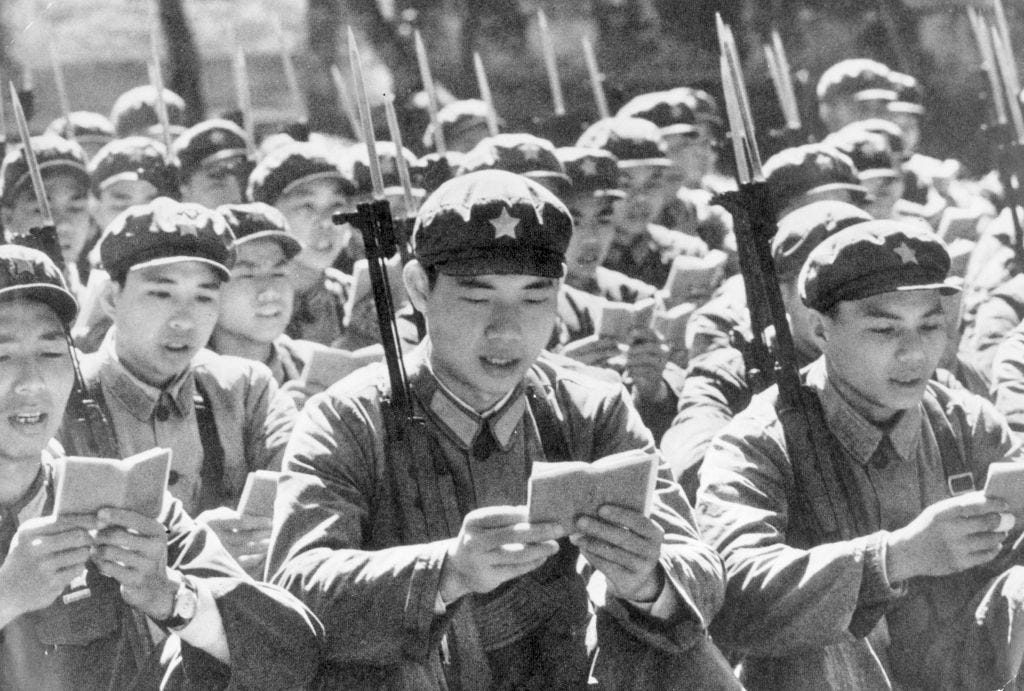
In the first week I was at college, in September 1966, I attended a campuswide lecture by the renowned China scholar John King Fairbank. Something big is happening in China, he said. But we’re not sure exactly what it is. The mystery was because China was then so sealed off from the outside world.
That something turned out to be the launch of Mao’s disastrous Cultural Revolution, then just dawning, which unleashed forces of nihilism, victimization, and violence across the country through most of the following decade.
Keep reading with a 7-day free trial
Subscribe to Breaking the News to keep reading this post and get 7 days of free access to the full post archives.