
Nasty, Brutish, and Long.
Thomas Hobbes and Hieronymus Bosch, with insights on Tuesday night's spectacle.

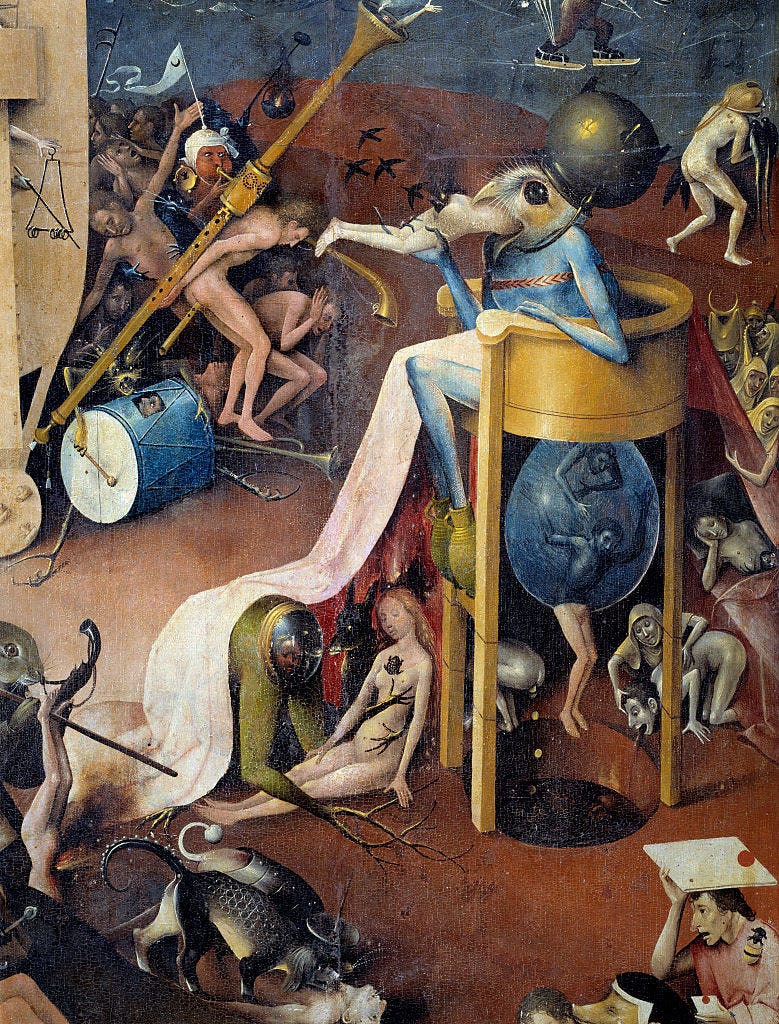
The scene in the Capitol two nights ago, as imagined by Hieronymus Bosch more than 500 years ahead of time. (From panel depicting Hell, in ‘Garden of Earthly Delights,’ at Prado Museum in Madrid. Photo Leemage/Corbis via Getty Images.)
-I didn’t write about Donald Trump’s performance at the Capitol on Tuesday night, because I couldn’t stand to watch the whole thing. I turned it off when it still had 45 minutes to go. For context: All presidents from Richard Nixon through the first George Bush kept their SOTU addresses near or below 45 minutes, total. One of Nixon’s lasted only 28 minutes. One of Reagan’s, just 31. Two of Carter’s, just 32 each.
-And I didn’t write about it yesterday, after going back to watch those last, lost 45 minutes, because after doing so I thought: This is too horrible to deal with.
-But today is a new day. So here, in listicle form—which, as it happens, matches the “structure” of Trump’s rambling two hours on stage—are a few points that struck me about what we’ve been through.
For a little more context: Before the speech, I’d done a set-up article about how SOTU’s “normally” work, and where I thought Trump’s might diverge. It turns out that my imagination was not nearly dark enough.
Thus the listicle.
1) No one will be talking about this speech next week. But it still matters.
The speech is already moving into the “old news”/ “asked and answered” category, driven out by the latest, smoking-gun Epstein cover-up revelations, and the possibility of unauthorized, open-ended, politically motivated war with Iran. And whatever tomorrow brings.
But the speech “matters” in the way several other also-terrible, also-mostly forgotten performances by Trump still do. For instance: Less than five months ago, Trump gave a 70-minute rant to a captive audience of some 800 US admirals and generals, dragooned from around to world to hear their Commander in Chief and “Secretary of War” boast and preen. That speech is hardly mentioned now. But I know it lives in the minds of military leaders. I can imagine future histories of US civil-military relations, or the excesses of the Trump years, built around this event and its aftermath.1
Similarly: Just last month Canada’s Mark Carney gave a speech at Davos that is still cited in the news and will also, I think, play a role in histories of our times. News stories no longer bother even to mention Donald Trump’s resentful, incoherent response from the Davos stage the very next day. But I can imagine future histories of the Trump-era “rupture” in world order built around that two-speech, back-to-back Carney-Trump sequence.
As for what we heard two days ago? People writing about our times will, I think, say it “mattered” mainly as a signifier. As an illustration of the state of the Republican party, it showed how utterly servile the Congressional GOP had become. At normal SOTUs, members of the president’s party pop up for planned applause lines every few paragraphs. This week, JD Vance and Mike Johnson were like marionettes or seals, popping up to lead vigorous applause every few sentences. Future historians will also consider this a window into the state of the president. That is, of how many of his character flaws and cognitive struggles were on display.
2) The speech had different modes: Bad. And also bad.
As mentioned in the previous dispatch, SOTUs are hard for presidents. Partly because so much “policy stuff” usually has to be crammed into them. Partly because most of the delivery has to be read from a prompter.
—The prompter part of this week’s speech sounded bad, because Trump has never mastered this harder-than-it-looks skill. He still stumbles on big words. When reaching the “writerly” parts of the speech, like the intro and the conclusion, he still sounds like a reluctant schoolboy, called on to read aloud from an assigned book in class. He never sounds like someone expressing thoughts that had occurred to him, in words he would naturally use.
—Those “writerly” parts sounded all the worse, because of … well, the writing. Look at the beginning, or the end, of this full AP transcript. To me, they combined the verbal grace of a middle-school speech-team contestant, with the tact and humility of a Pam Bondi when testifying, with the rigorous honesty of a Karoline Leavitt or Kristi Noem in the briefing room. With the open-heartedness of a Stephen Miller connecting them all.
—And those were the “prepared” parts of the speech. The parts that together were supposed to be “on message” and “inclusive,” and offer Trump a “reset.” All the rest, nearly half by tonnage, was recycled rally material. “I am the greatest.” “Everyone is unfair to me.” “Anything that’s wrong is Joe Biden’s fault.”
And all of it met with rapturous GOP applause.
3) The act is getting old.
An enormous part of Donald Trump’s appeal is that he’s been interesting. Precisely because people never knew what he might say or do next, they watched to see what that “next” might be.
This speech was racist, full of lies, narcissistic, divisive, and so on. The examples and details have been reported everywhere. By now, all of that is baked in.
The difference this time is that the speech was boring.
Trump himself seemed bored with the “policy” parts. And during the “riff” parts, he was performing as if he had to, with low energy. And unlike riffs before a rally crowd, he couldn’t vibe-surf with the audience, and play up the parts they liked best. The on-scene GOP audience gave him little guidance, since they cheered for whatever he said. He could get no real-time sense of how it was all playing on TV.
As pointed out previously, some of Bill Clinton’s longest SOTUs were distinctive in that the TV audience kept growing through the course of the speech. People liked hearing about the details. I haven’t seen figures for this latest Trump extravaganza. But I bet they’ll show that viewership went down, down, down as the speech went on, on, on.
The act is getting old.
4) Divisiveness and hostility.
An obvious point, but for the record: A SOTU is any president’s best opportunity, once a year, to reach a broad national audience, beyond the hard-core base.
Trump barely even pretended to care about anyone but MAGA loyalists. “These people are crazy,” he said about Democrats as a whole, when they refused to stand for one of his lines. And continued:
We’re lucky we have a country. With people like this—Democrats are destroying our country. But we’ve stopped it just in the nick of time, didn’t we?
Another time he tried to “trick” the Democrats, with a question that boiled down to “stand up if you care about real Americans.” They didn’t take the bait. Trump then theatrically paused and surveyed the seated part of the audience: “You should be ashamed of yourself for not standing up,” he said, shaking his head back and forth in a scolding, “I’m so disappointed” way. He paused again, for the obviously planned kicker: “You should be ashamed of yourself.”
Ah, yes, the healing power of a lecture on shame, from a veteran of the Access Hollywood tapes and Epstein files.
In SOTUs presidents rarely call out their predecessors by name. Four separate times Trump said that the country’s remaining problems all traced back to Joe Biden.
5) A creepy obsession with gore.
Keep reading with a 7-day free trial
Subscribe to Breaking the News to keep reading this post and get 7 days of free access to the full post archives.