
It's SOTU Time!
Five viewer-tips for making the most of Tuesday night's event.

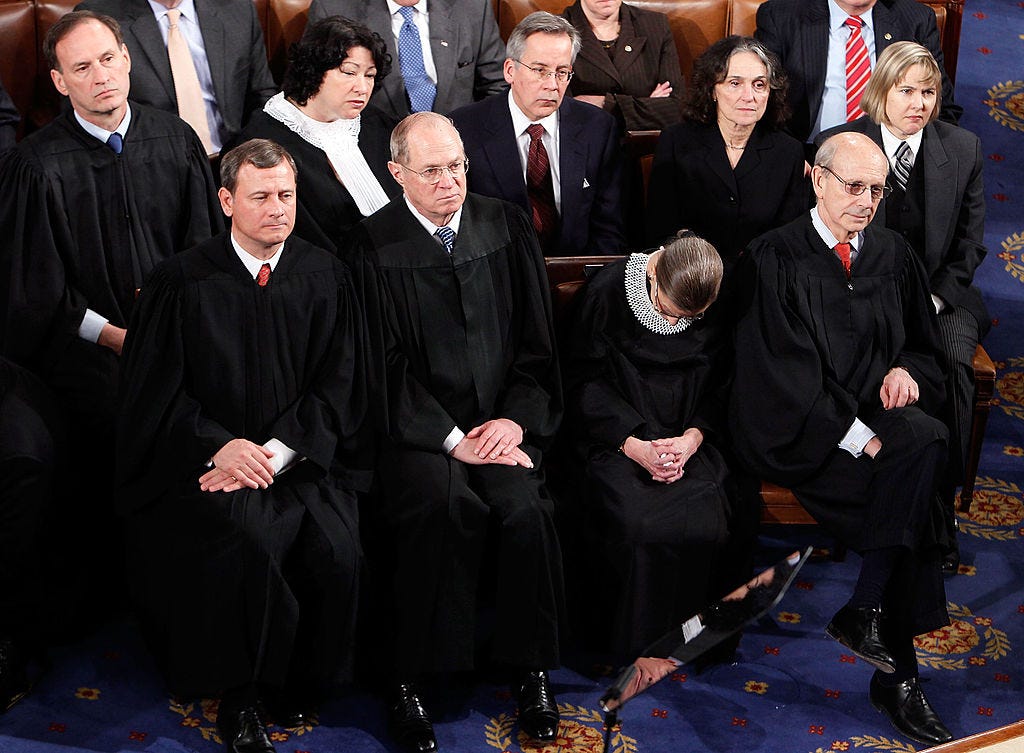
Samuel Alito, at the upper left, is not liking what he is hearing from Barack Obama, when Alito and five other Supreme Court Justices attended Obama’s 2010 SOTU. Days earlier, the Court had issued its disastrous Citizens United ruling, which Obama correctly said would “open the floodgates for special interests, including foreign corporations, to spend without limit in our elections.” While his black-robed colleagues sat poker-faced, Alito frowned, shook his head back and forth, and said loud enough for microphones to pick up, “Not true!” He has not attended any SOTU since then.
Now Alito has been called out by Donald Trump as one of the “good” judges, for his pro-Trump vote in last week’s tariff ruling. Might he show up this time? Which of his colleagues will decide to go? Will John Roberts abide by his tradition that The Chief should always be there? These are some of the many details to look for on Tuesday night. (Photo Alex Wong/Getty Images)
In a normal four-year term, a US president can count on exactly four occasions to reach a live TV audience of at least 40 to 50 million people, for uninterrupted airtime of an hour or more. These four chances are the president’s State of the Union addresses, or SOTUs, which come early in each year, usually between late January and early March.1
These addresses are rarely remembered for their rhetoric. The presidential lines that go down in history are mostly from inaugural speeches: “With malice toward none.” “The only thing we have to fear.” “Ask not what your country can do for you.” Probably the most memorable line from a modern SOTU has gone down in history in ways its authors would rather forget. That was George W. Bush’s SOTU declaration in 2002 that Iraq was part of an “axis of evil,” whose “weapons of mass destruction” had to be removed by force.
But SOTUs stand alone in the platform and attention they provide a president. Bill Clinton still holds the SOTU record for the biggest live TV audience, of more than 66 million in 1993. Since Clinton’s time, live TV audiences have ranged from the low-40 millions to the low-60 millions. Those may seem small by Super Bowl standards (around 120 million) but are much larger than the TV audience for anything else a president does, including inauguration speeches or Oval Office addresses.
Clinton also normalized the pattern of SOTUs lasting an hour or more. For comparison: One of Ronald Reagan’s SOTUs was 31 minutes long. One of Jimmy Carter’s, 32 minutes.2 But most presidents who followed Clinton have spoken for an hour, or a little more. In this as in other areas, Donald Trump has been an outlier. Last year he spoke for nearly 100 minutes, by far the longest SOTU ever, padded by rally-style improvisations, and ending near 11pm Eastern time.
Bill Clinton’s example is relevant in another way for Trump’s upcoming speech. The first time Clinton broke the one-hour barrier, media pundits made fun of his long-windedness. But TV ratings soon showed that his audience had steadily grown as the speech went on. People were telling their friends to tune in. Most of his later speeches matched this pattern: He wanted to talk about policy details, and that’s what many viewers wanted to hear.
Donald Trump’s speeches, especially last year’s, have shown the opposite pattern. According to Nielsen, his audience peaked in the first 30 minutes of his speech, at around 38 million, and steadily fell after that. People had heard the riffs before.
That’s the back story on why these speeches matter. Now, here’s what I’ll be listening for, two nights from now:
1) ‘What makes this SOTU different from all others?’
Administrations come and go. One internal struggle never changes: That is the battle between the vast majority of officials and departments in the government, on one side, and a tiny little tribe of speechwriters on the other. Both sides know the speech “matters,” because of its audience. But they think in different ways about how it should matter.
—Most of the government spends a year trying to cram details into the SOTU. Their arguments boil down to: “If we don’t mention [this spending program or tax cut or treaty], then [this Senator or Congressman or donor or voting bloc or allied country] will be pissed at us, and we might lose [this crucial midterm or upcoming Senate vote].” Thus a growing stack of “must include” sentences, paragraphs, and commitments to fit in somewhere.
—Meanwhile the little team of speechwriters keeps saying, “But this is the administration’s one big chance per year to present a Big Idea! To re-introduce ourselves to America! To have our version of ‘New Deal’ or ‘Morning in America’! To avoid the clichéd ‘laundry list’ of SOTUs and concentrate on one uplifting theme!”
The writers also know that Bill Clinton was the exception, For most presidents, the more they get into the weeds, the more the audience tunes out.
We all know how this David-v-Goliath battle turns out. The Goliath of the Laundry List prevails. That’s why the speeches are so long. And for Trump speeches, the battlefield is especially complicated because of his fondness for the impromptu stylings he calls “the weave.”
Is there any hope of the pattern changing in this next speech? That this Trump speech will be different from all others? We can all guess. We’ll know within the first five minutes, which is when any “thematic” speech needs to declare itself.3 That is my first viewer-tip.
2) Way harder than it seems: The weird formalities of a scripted speech.
Most people who end up as president are good at in-person presentations to live audiences. That’s how they got ahead in politics to begin with. Eye contact, reading the room, improvising—at fund-raisers, at rallies, during informal Q-and-As.
But certain parts of being president involve surprisingly different communication skills. There are presentations you can’t just wing—formal ones like inaugural speeches or SOTUs.4 There is specific legal, diplomatic, and legislative language you have to state precisely, which means exactly following a prepared text. There are many circumstances where you can’t possibly read an audience’s reaction—because you’re sitting there looking at moving text on a prompter, with a TV camera behind it. In person, you can tell what lines are boring people, and which are making them sit up. Speaking to a camera, you can only see those scrolling prompter words.
Learning to do these things effectively is hard!
—Ronald Reagan came to office knowing how to do all this. That was not so much because he’d been an actor. Mainly it was because he’d been an announcer, and a radio commentator.
—For most other presidents, this kind of communication is new, and they must work to develop ease with it. George W. Bush started out quite awkward at “set speech” presentations, and got much better. Jimmy Carter was brilliant as an extemporaneous small-crowd speaker but resisted mastering the artifice of TV. (For the record: I was Carter’s chief White House speechwriter at the time.) Barack Obama was already skilled by the time he came to national attention with his 2004 Democratic Convention speech. Most other presidents are somewhere in between.
The challenge and problem for Donald Trump is that his natural speaking style is the exact opposite of what these formal occasions require. To the best of my knowledge, he has never once delivered a speech in the style that works best for SOTUs :
Trump loves the ramble, the ‘weave,’ the ‘sir’ stories. He loves the lines he’s used a million times. He loves the boasts. He loves the personalized attacks. These make up the heart of his rally speeches, and they are “greatest hits!” favorites with his base. But the entire point of a SOTU is the once-per-year chance to reach beyond the base.
Trump doesn’t like reading from scripts and prompters, and is comically bad at it. He stumbles over “big” words or “hard” names. When sticking to a script, he will offer commentary—“You know, that’s so true”—after reading a line he is obviously seeing for the first time. You have to practice to sound natural in these structured settings. He does not appear to have put in that work.
Trump loves to rile up audiences he knows are on his side. He loves riling them up with resentment, with complaints about unfairness, with warnings about how evil the other side is. This creates a problem with both segments of his audience for a SOTU. The in-person audience within the Capitol has only a slight MAGA majority, and includes people Trump has called out as “low IQ,” “losers,” “RINOs,” and “Communists.” Trump is most animated and “interesting” when on the attack, or in pro-wrestling-style kayfabe. But (except at press conferences) he’s not used to attacking people to their face. Meanwhile, the vastly larger audience watching on TV will not be MAGA-only.
You get the point. Here the viewer-tip will apply to the first 15 minutes of the speech. That’s usually as long as Trump can stay “on message”: Sticking with the script, reading the prompter as if he’s seen the words before, omitting the “like nobody has seen before” or “prices down 800%” marginalia, sounding as “big tent” as MAGA policies allow.
If he lasts that long, it will be a sign of a different kind of speech from what we’ve come to expect. But if he reverts to form in this opening stretch, when the audience will be largest, even with a few casual riffs that make him feel comfortable but aren’t in the script, we’ll know what the rest of the speech will be like.
3) Who will be ‘Lenny Skutnik.’
Not long before Ronald Reagan’s 1982 SOTU, there was a terrible airplane crash outside National Airport in Washington. Lenny Skutnik, a federal employee in his late 20s, was one of the civilian-heroes who jumped off a bridge into the frozen Potomac to rescue a passenger who was about to drown.
At Reagan’s SOTU, Lenny Skutnik was in the First Lady’s Box, with Nancy Reagan. Ronald Reagan called him out as an example of American heroism.
Ever since then, invited guests have played the role of inspiring examples, or sometimes just props, for a president’s message.
Which guests will Donald Trump choose to sit alongside Melania? (Assuming that she attends.) Might it be someone “inclusive”—from Ukraine, perhaps? Or perhaps a Latin American or African immigrant who struggled to reach America and has enriched our culture?
Or, by contrast, someone whose story is aimed at “the base”? The victim of crime from a “worst of the worst” immigrant? An ICE or CBP member injured in the line of duty? A small business owner helped by tariffs?
Viewer-tip: Watch who is placed in the Lenny Skutnik seats, and the rhetorical use Trump makes of them.
4) And what about SCOTUS?
Supreme Court attendance at SOTUs is a relatively modern “tradition,” starting mainly in Lyndon Johnson’s era. Over the years, individual Justices have made a point of attending, or not. However many come, they’re in the front row at the Capitol, unavoidably in the president’s immediate line-of-sight.
Whatever these nine people decide—individually, and as a group—will carry exceptional weight this time.
Keep reading with a 7-day free trial
Subscribe to Breaking the News to keep reading this post and get 7 days of free access to the full post archives.