
Stand Up, Stand Together.
Two guiding principles of the No Kings movement, and for Americans meeting this moment.


Some of the 2,600+ planned sites for tomorrow’s ‘No Kings’ demonstrations, across 50 states plus DC, Puerto Rico, Guam, and beyond. As the MAGA regime becomes ever more lawless and destructive, the principles of standing up, and standing together, matter all the more. (To search this interactive map for a local event, go toNoKings.org.)
This post is a “where we stand” update, on the eve of what could be one of the biggest mass demonstrations in US history.1
It’s based on the tension between the two contradictory realities of the second Trump era, which have become all the starker in the past few weeks.
That is the tension between: How much damage Trump can keep doing, how fast, versus how quickly the rest of us can stop him.
More than mere tension, it’s become a race.
-On the one side, we have Donald Trump, with his MAGA enablers and lackeys from Congress to the Supreme Court, growing more lawless, more reckless, and more destructive every day. Some all-too-familiar particulars are in notes below.2 Even without stopping for the details, we all recognize that each news cycle brings word of additional corruption, intentional cruelty, delusional power claims by a visibly deteriorating3 79-year old who seems actually to believe that being president means “I can do anything I want.”
Some courtiers around him must know better. Starting with Pam Bondi, Scott Bessent, Mike Johnson, and JD Vance. Others conceivably don’t, for example RFK Jr or Pete Hegseth. I’m not sure which category fits Karoline Leavitt. But whatever their level of awareness, all of them, exemplified by Bondi and Leavitt, are ever more strident and huffy, as they defend Trump’s ever loonier claims, and insist that the emperor is indeed wearing beautiful new clothes.
The front page of yesterday’s print New York Times deserves its place in the history books, for registering this part of our Trump II reality.
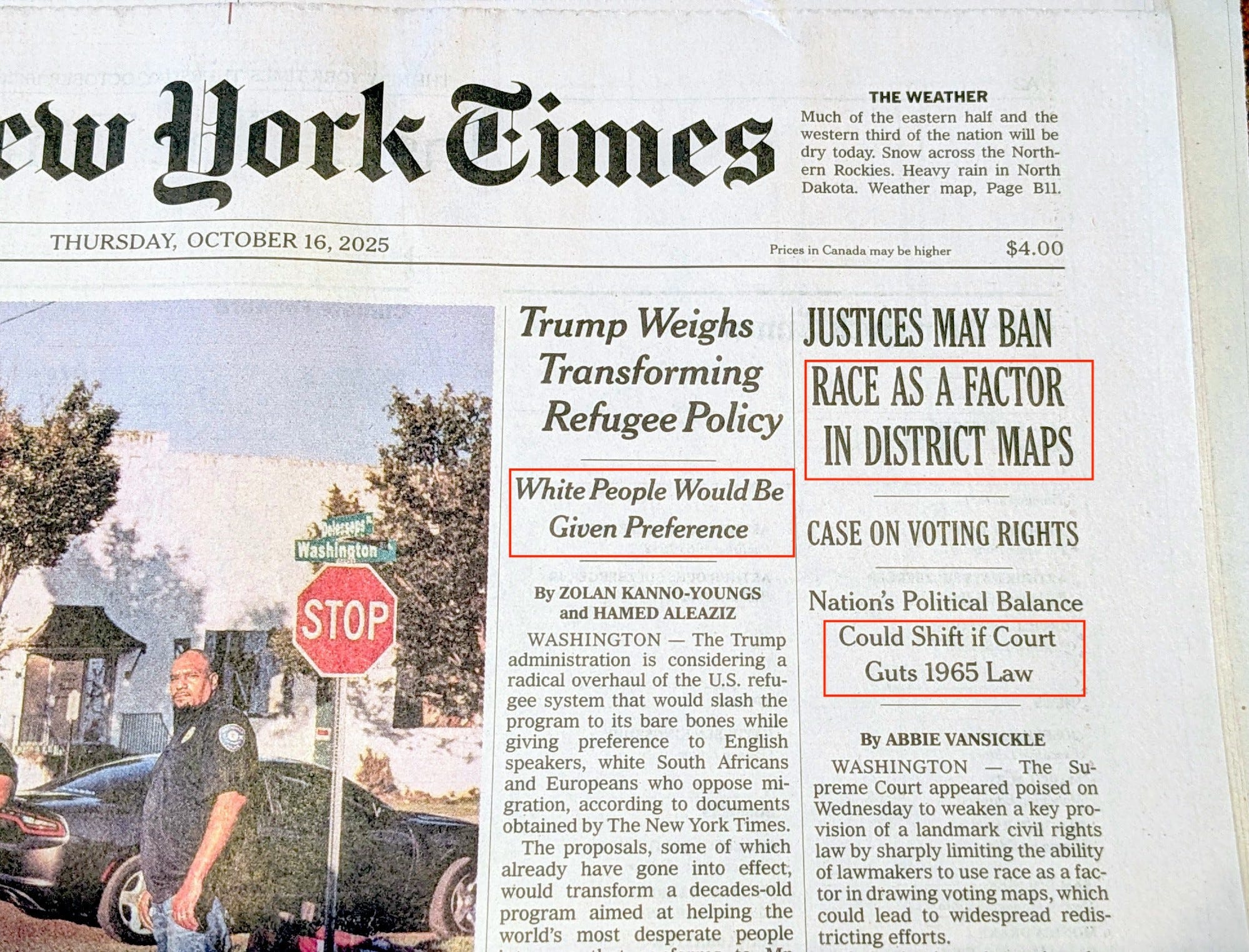
The highlighted story on the left says that, according to the administration, race should be a factor, when it favors white people for immigration. The story to the right says that, likely according to the Roberts Supreme Court4, race can be banned as a factor, when it favors non-white people in electoral maps.5
—But the other reality is that this same MAGA faction is ever weaker, ever less popular, ever more subject to sand-in-the-gears resistance. This pro-democratic friction has come from courts (at the local, state, and federal-district level), from mayors and governors, from universities and libraries other civic institutions. It has come from foundations and NGOs, from artists and writers, and from ordinary citizens, across the country and in growing numbers. Practically none of it has come from the business, financial, or tech communities.6 (Here is a recent, rare exception.)
In full “Flight 93” panicked awareness that time is not on their side, the sentient members of the MAGA team are now rushing. They’re trying to lock in as much as they can, as long as they can.
What has changed, since the DOGE-chainsaw days.
The two sides of this struggle might seem the same as in the DOGE-driven Chainsaw-Cultural-Revolution era six months ago. The difference is the sense of the inevitable.
At the start, universities like Columbia, and law firms like Paul Weiss, knuckled under to Trump, because they thought their only choice was surrendering now, or surrendering later. Resistance was futile, it seemed. They thought they didn’t have the cards. “We are all afraid,” as Sen. Lisa Murkowski put it, in the remark most likely to be remembered from her entire career. This is the calculation that explains the complicity of the Congressional GOP as a whole.
The mood in parts of DC and elsewhere was like the mood in Kyiv, immediately after the Russian invasion of 2022. Opposing forces were overwhelming. Defeat was inevitable, perhaps in a matter of days. But in those terrifying first days, from the darkened streets of the capital, Volodymyr Zelenskyy recorded his Churchill-like brief inspirational video message: “We are all here,’ he said with his cabinet ministers around him. ‘We will remain here. We will defend the independence of our nation.” Defiance and bravery, against the odds.
I can’t say what will happen with Ukraine. But on the eve of No Kings, the odds appear to be changing within our country. The secret seems to lie with the American individuals and institutions that have recognized the combined power of two consistent strategies:
-Stand up. Do not obey in advance (as Timothy Snyder put it). Make the other side fight for every inch. And even if you’re destined to lose, at least go down in a way you’d hope will be remembered. With your dignity and self-respect intact.
-Stand together. Courage actually is contagious—as are cowardice, and capitulation. Battlefield experts say that soldiers don’t charge into lethal fire for “their country.” They do it for the soldiers alongside them, all moving ahead. Even in far less dramatic circumstances, people behave differently when they think they’re not alone. It matters to know that people you’ve never met, from places you might never go, are standing up as well.
All this is of course the logic of the No Kings demonstrations—as it was for the Civil Rights movement half a century ago, and the Suffragettes before that, and all other social movements that mattered through our history.
The rest of this post is to give a few recent examples of organizations and people that are standing up, and standing together. And that appear to be making a difference.
1) Journalism at the college level: The kids are all right.
College newspapers matter more to American journalism than people outside the business may be aware. I’m biased, as a one-time college newspaper editor. But that exposure has made me aware of how many of the country’s grown-up reporters and editors and writers and artists and photographers got their start at a college paper. It’s like a vastly worse-paying (but less physically damaging) version of the NCAA’s role in staffing the NFL and NBA.
Across the country, through higher-ed controversies of recent years, college papers have consistently shown up the professionals in balanced, realistic coverage of campus upheavals. Now many of them are standing up, and standing together, on Trump-era national issues.
This past summer, in August, the Stanford student paper The Cardinal took the lead as plaintiff in a suit against Marco Rubio, Kristi Noem, and MAGA generally. The suit argued that Trump-era visa and DHS rules, including deportation based on political writing, constrained freedom of speech for international students who were legally in the US. More details, and a rationale from the student editors, are available here.
That was “standing up.” The “stand together” part happened this week. Two days ago, fifty-five more college newspapers jointly signed an amicus brief, supporting Stanford’s position and opposing politics-based visa and deportation rules.
You will feel better about America if you just glance down the list of papers supporting this action, which you can find on the Student Press Law Center site here. (A PDF of the full amicus brief is available there.)
Alphabetically the first on the list is The Alestle newspaper, of Southern Illinois University at Edwardsville. Last by alphabet is the Yale Daily News, of Yale. In between are institutions big and small, public and private, rural and urban, east and west, north and south, world famous and locally known, highly selective and open-admissions.
The Crimson White, of the University of Alabama, and The Crimson, of Harvard. Papers from Western Kentucky University, and Princeton. The Vanderbilt Hustler, and The Maneater from the University of Missouri. Small and large papers from Florida to Alaska. Many of these papers have also run their own editorials about why they support Stanford’s case. For instance, this from the University of Washington Daily. Or this, from the Brown Daily Herald. Or this op-ed by Harvard faculty members in The Crimson. (For whatever reason, the Columbia Spectator is the only Ivy League paper not to sign on.)
It’s a big swath of Kids These Days. Each of them is taking a risk in standing up, and they’re stronger because they’re standing together. It’s a reason for hope.
2) Journalism at the professional level: The Pentagon press corps is off to new missions.
The censor-like demands Pete Hegseth’s Pentagon made of national security reporters were clearly unacceptable.
Keep reading with a 7-day free trial
Subscribe to Breaking the News to keep reading this post and get 7 days of free access to the full post archives.