
Speechwriting, Then and Now.
A discussion with David Litt, 20-something speechwriter for Obama and author of a wonderful new book—not about politics. In a blurb I call it "an instant classic." In our discussion I explain why.

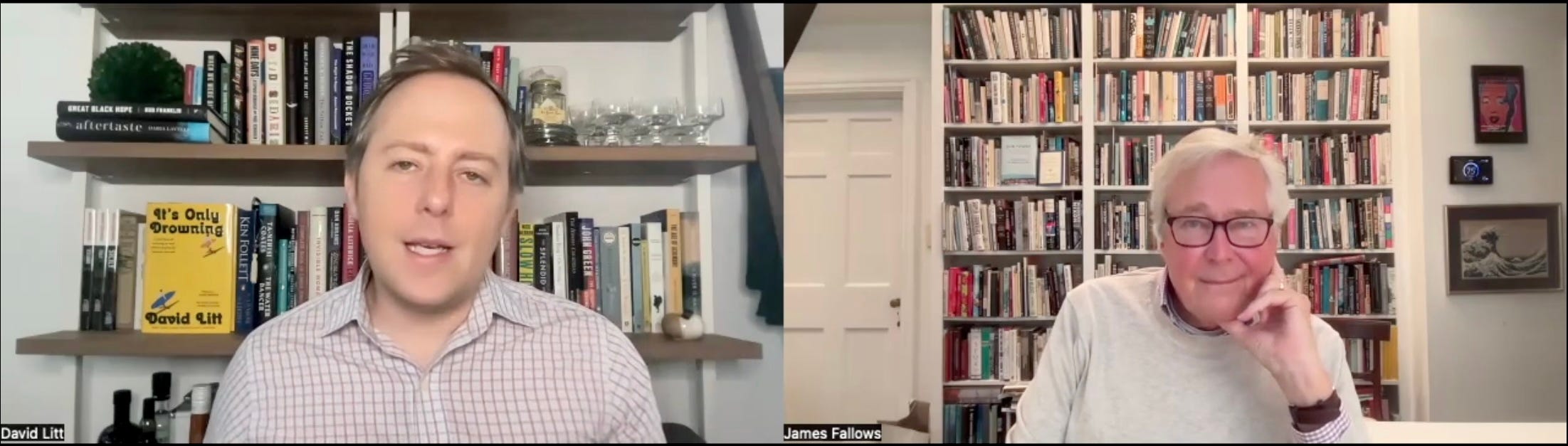
Two former White House speechwriters comparing notes. One of them, at left, has a great new book about learning to surf: David Litt, with It’s Only Drowning.
David Litt and I have one thing in common: We worked as White House speechwriters while in our 20s.
Our differences, apart from the obvious generational ones, begin with David having been a writer for Barack Obama—who, despite other complaints and critiques, was renowned as an orator. While I worked for Jimmy Carter—who, despite other admiration and praise, is not mainly remembered for his addresses as President. (Though some of them were actually good!)
This week David Litt has a wonderful new book coming out. It’s not about politics—or not about it directly, which is the best way to deal with divisive issues. Instead it’s about his decision, in his 30s, to learn a skill in which he’d had no previous experience or mastery: Namely, becoming a surfer. And what he learned about himself, and people, and the country, and life in the process.
The book is called It’s Only Drowning: A True Story of Learning to Surf and the Search for Common Ground. In a blurb I called it “an instant classic,” and even allowing for the structural politesse of blurbs I stand by that. You’ll be glad to have read this book, will laugh while reading it, and will learn things along the way.
My Standing-to-Speak: Having grown up in the Southern California of the Beach Boys era, I always wished I knew how to surf “for real.” But in fact I only body-surfed, with my brother and our friends at “The Wedge” in Newport Beach. David, who grew up in the East, took it the whole way.
As it happens, three of Deb’s and my granddaughters, ages 6 through 11, live on the Southern California coast and have already learned to stand up on their surf boards. Their little brother, age 2, is on his way.
Here’s a video of my talk with David Litt a few days ago (including an intro 30 seconds of stage business), and an edited transcript below. David has also posted the video on his site.
I enjoyed the conversation, and the book, and think you will too. Congratulations to David and his readers.
Full Transcript: Jim Fallows Interviews David Litt, lightly edited and condensed.
JIM
My name’s Jim Fallows. We’ll talk about former Obama speechwriter David Litt’s recent and excellent book, It’s Only Drowning. David, welcome.
DAVID
Thank you for having me.
JIM
So, just to start out telling people who have not yet read the book — why surfing? Why this story? After writing books about working in politics with your books Thanks, Obama, and Democracy in One Book Or Less, why write about learning to surf?
DAVID
This book is a departure from my last few in some ways.
Originally, I thought, “Okay, this is a fun story about falling off surfboards,” and that’s still true, but the more time I spent in the water and working on the book, I realized this story is really about me and my brother-in-law Matt. He’s my wife’s younger brother, who is Joe Rogan’s biggest fan, and we’re completely different. We became unlikely friends through this shared hobby, surfing.
The split between us is not just personal, but also reflects what’s defining our country. And the friendship shows that, in a moment that often feels hopeless, we can still have relationships across cultural and political divides.
JIM
I want to talk about the surfing to begin with. *Holds up first page of book with two photos of surfers* Can you describe the two photos and the captions on them?
DAVID
If you thought the cool-looking surfer in a barrel inside a wave on the top is Matt, you would be right. And if you thought the out-of-shape surfer falling off a surfboard and flailing his arms aimlessly is me, you would also be right.
JIM
What did you learn about the larger process of doing something that’s embarrassing? What was that like, and why did you decide that it was worth it?
DAVID
For me, that fear of embarrassment was very powerful, and it kept me from doing a lot of things in life. I started as a speechwriter for President Obama when I was twenty-four, which was wildly lucky. I had an accomplishment in my 20s that was pretty rare. In my 30s, however, that sense of achievement held me back. When I tried new things, I knew it was never going to be — at least on my resume — as interesting or advanced.
Learning to surf was a discipline in becoming comfortable with embarrassment in public and with being bad at something.
Those two things — learning to say, “I’m going to be bad” and “I’m going to do it again anyway” — are muscles that are absolutely worth strengthening.
JIM
What were the particular things that were hardest to master about surfing?
DAVID
I’ll answer your question in two ways, one physical and the other more emotional. Physically, the hardest thing about surfing was everything. In a way I had not anticipated. There are muscles that are involved in surfing that I had taken for granted and were suddenly being used. Learning to surf would have been a lot easier when I was younger.
The biggest emotional thing for me was learning how to handle the overwhelming sense of fear — being in the ocean and having a wave about to clobber you. During my second lesson ever, I asked the instructor, “I’ve noticed this interesting phenomenon where every so often the wave looming up behind me is about to break and feels like it will kill me. Anything I should do?” I thought my instructor, Katie, would tell me how to avoid the situation. “Oh!” she said. “That’s the flower of fear!”
What she meant was that instead of running away from fear or overcoming fear, for surfers there’s this idea of embracing fear.
Without that fear, you’re not in the right spot. The wave is telling you to paddle out. I’ve come to believe this not just with surfing but in other moments when courage is called for. Fear doesn’t always mean you should run from it or overcome it. Sometimes you’re already in the right spot.
JIM
One of the themes of the book is David discovering David. The other is David and Matt, your brother-in-law, a veteran surfer with different political views than you. How did he come to respect your surfing accomplishments by the end of this journey?
DAVID
I think it’s fair to say, out of the water, I am much closer to being “the establishment” than Matt is. I’m a Yale-educated writer who uses two computer monitors for work. Matt is an electrician who is covered in tattoos and drives a pick-up truck to work. In the water, it was switched. Matt is the establishment. He absolutely had the unwritten surf law to reject me, but he never did.
In addition to a lot of practice, Matt just has a lot of natural talent. In a strange way, I think he thinks to himself, “This person is so obviously unqualified for this, and yet they insist on trying. And there’s something about that I respect.”
JIM
There’s been a recent big piece in The New York Times opinion section. I view it as chapter four million of the ‘guy in a diner’ saga.
I’ve gotten a little tired of accounts saying we need to be more empathetic to the sense of lost pride among one particular group, white men. Tell me how you distinguish class and economics in this book from being episode four million and two in the ‘guy in a diner’ saga.
DAVID
Not being reductive was important to me. I think it’s unfair to those reading and also unfair to the people in the diner. It reduces people to just their demographic characteristics.
What I learned through three years surfing with Matt — including a year not in the book — is that we’re more interesting than our demographics would suggest. For example, he reads more than I do, which is surprising to readers who assume “Matt must not read.” There’s a moment in the book where we discover that we both love Taylor Swift. That was a point of connection.
To make another point, I’d go back to the Obama campaign. I was a field organizer. My first job out of college took me to Wooster, Ohio, a college town and dairy county. We’d talk to people who said, “Obama is a Muslim terrorist, so I’m never going to vote for him.” What we were taught as organizers was you don’t have to validate people’s incorrect facts but you do have to treat people’s feelings as valid.
When you got to the bottom of it, their concern was almost always a policy one. They would say, “I feel like white people have treated black people so badly that if Obama becomes president, he’s going to want revenge.” I would say, “I’m a white person. If I felt that the president was going to try to take revenge on me, I absolutely wouldn’t support that.” I think treating people’s feelings as real is different from treating their worldview as correct. I don’t think resentment justifies everything, but I do understand how people could feel like politicians don’t care about them. And President Trump panders to those resentments.
[A quick reminder: It’s Only Drowning comes out tomorrow, and you can get a copy from Amazon, Barnes & Noble, or an independent bookseller via bookshop.org.]
JIM
That’s well reasoned, and I’d add that my wife Deb and I wrote a book called Our Towns. We talked to people across the country, especially in smaller towns, and found most people on most topics can have a reasonable discussion, including on disagreements. The cancer of the moment is that national politics has reduced that capacity and inflamed people.
Going back to the door-knocking anecdote and white people who thought Obama would take revenge on them after centuries — why do you think in the most recent presidential election, a larger than expected number of blacks and Latinos and immigrants, all of whom might expect revenge from Trump, would have still voted for him?
DAVID
That’s a good question. I feel like you’re trying to get me in trouble, which makes it fun. I do have some insight because these days, Matt and I know each other well enough where I can just ask him stuff. I’ll give you an anecdote I think explains a lot of this. In December of 2024, Matt and I went to Waco, Texas, and I talked about how I was surprised as a Democrat that all of those Latino voters voted for Trump. In the end, I thought they’d swing back to Democrat.
Matt said, “Oh, I could have told you what’s going on.” Matt is an electrician with lots of Hispanic people on his job site. “They love Trump. Not him but 100% the economics. They think he’s going to put money in their pockets.” I asked him more recently, “What do they think now?” He said, “I don’t know, they’re gone.” They just haven’t been showing up, which reminds him of the pandemic. There’s a lot of fear, which is changing people’s behavior in ways that are totally understandable.
I feel like what I ended up learning was about this split. People stopped, to some extent, voting along racial lines, and started voting along the lines of gender, blue-collar vs. white-collar, other divisions that Trump was able to exploit.
JIM
Let’s talk about speechwriting. Relatively recently, Gavin Newsom gave a sort of “Go to Hell” speech in response to Trump. What impressions did you have about it?
DAVID
I didn’t see the whole thing, I saw internet clips. That was my first impression. Most people now see clips, where in the past, people would read a speech in the newspaper or watch it on television.
It was interesting that Newsom’s speech was a return to formal speaking at a moment when casual is in, with podcasts and Joe Rogan. This whole idea of being sloppy and casual and authentic. Newsom seemed authentic, but it was a very written speech, which I hadn’t realized was so rare until I saw it.
How would you answer that question?
JIM
I was in California at the time, and I saw it in real time. It was only six-and-a-half minutes long. It was keeping in the way of FDR the morning after Pearl Harbor or Ronald Reagan after the Challenger explosion — addresses in times of stress — because Newsome didn’t know what was going to happen in Los Angeles. I thought it was formal in an intentionally informal way. If you look at the actual text he spoke from, most of the sentences were just one sentence long. Not even sentences, just phrases. I thought it did the right job of sounding stern and respectful but also defiant.
Tell me what you think when you hear our current president speak.
DAVID
Most recently, what struck me was that during the military parade during his birthday, Trump spoke off the teleprompter. He hates being shackled, so this was his version of retreat, thinking “I need to be careful and not start doing the weave. I can’t turn this parade into a series of political attacks.” It’s a moment for all the Democrats to see that Trump and MAGA don’t have it all figured out either.
JIM
I think Trump is absolutely terrible on the teleprompter. He can barely read. He only comes alive when he can make his speech a rally speech, which is why his State of the Union and latest Inaugural Address were four times longer than they should have been because he was just riffing.
Am I being too harsh in judging his teleprompter skills? How do you view his speaking style?
DAVID
It’s funny that what immediately comes to mind was the moment I saw my brother-in-law Matt in a tuxedo for the first time at a wedding. He looked miserable. Someone was telling him what to wear, and he was frustrated by it.
Trump, when he’s on the teleprompter, looks like somebody forced to wear a suit and tie against their will. He just seems to resent it so much. It recently occurred to me,“Wait a second. For this man who had this famously controlling and overbearing father, the only thing that seems to give him joy in life is the feeling that no one can control him.” I think that’s part of the prompter. If he chose to get good at the prompter, it would demonstrate that he was willing to do it. So by being bad at speaking off a prompter, I think in a strange way, he thinks of it as an act of defiance.
Thanks for reading Word Salad! Subscribe for free to receive new posts and support my work.
Subscribe
JIM
Tell us about some Democrats — particular people, messages, or approaches — that you have found interesting.
DAVID
We’re at a moment where a lot of flowers are blooming. What we’re seeing is new styles of communicating. For example, I think Pete Buttigieg has been fantastic and cerebral, which is very rare. For most people who think in public, it can be hard to connect with big groups of voters.
Then you have people like Jasmine Crockett, who I think are winning the internet and really engaging in disrespectability politics. People who just say, “I don’t give a crap about the powerful,” and that’s really appealing. They read as authentic, so that kind of disrespectability politics is in.
It’s an interesting moment. We don’t have an obvious front-runner or party leader, so lots of different people are trying their own thing.
JIM
On the other extreme, are there any Democratic messages now that have that fingernails on blackboard effect on you, either in their tone or the approach they’re taking?
DAVID
The one I would highlight is ‘TACO,’ which stands for “Trump Always Chickens Out.” It came up after he announced tariffs and then backed out somewhat. I think it misses the extent to which Trump chickening out is actually a political superpower for him. I think it’s appealing to voters who are not hardcore MAGA. So saying ‘TACO’ is not helping us, and this is a moment when winning is existentially important.
JIM
Existentialism brings me to my last discussion topic. This is the most trying moment for the American experiment during my lifetime. Even if 1968 was more violent — two historic, catastrophic assassinations, a president feeling as if he had to resign — there wasn’t the same sense of fragility of institutions that many people correctly feel right now. What would you tell younger people about the balance between hope and determination and fear and pessimism?
DAVID
One idea that is fundamentally American, even if we haven’t always lived up to it, is that in this country, We, the People should by and large get what we want. We should decide what happens next. That remains true even after six months of intense assault on our democracy.
I think Trump thought we’d be well on our way to being Hungary or Turkey with a de facto strong man. But mad kings are not what we do. That has surprised people who thought America would go down without a fight or that the fight was over. So the first thing I would say is that this is still a country where we believe that what we want matters.
The other thing I’d say is that we still want to figure out how to build something together. We don’t want to barely be speaking to family during Thanksgiving. Thinking we used to be friends with people, but we now can’t, because of a certain issue. The vast majority of us want something better than the divided and bitter world Stephen Miller wants. That’s what makes me hopeful.
When you’re writing a book, you’re deciding what question you’ll be asked a million times by everyone you meet. With President Obama, everyone would share their experience meeting or being near him. This time around, people tell me about a family member they have trouble speaking with because of politics. No one ever says, “And I’m glad about it.” Everyone wants this to pass, which is an important and overlooked piece. To quote my former boss, everyone wants to, “figure out how to disagree without being disagreeable.” It’s harder than it’s ever been, but it’s still something that we want.
JIM
What is a point or that you wished I’d given you the chance to mention that you haven’t?
DAVID
There’s a lot qualitative polling and qualitative focus groups on our political divides. This story is the sample size of one, the smallest you can get. I think by reading It’s Only Drowning, you’ll learn about these divides, how they were exploited politically and shaped our country in a way you wouldn’t otherwise know from a poll or focus group.
JIM
That is good to note. As someone who has read It’s Only Drowning and is encouraging other people to read it, that is one of the many things to learn. So, David Litt, thank you for writing this book, and we will see you on the trail.
I'm not entirely persuaded about the deemphasizing of politics that I understand Litt supports. Politics right now is driving matters of the greatest personal importance to Americans: the availability of health care, the kind of health care that will be available (such as vaccination), the cost of what they purchase (a function in part of Trump's tariffs and other economic actions), and the reach of federal law enforcement and even the military into their communities. That behavior, now roiling Los Angeles and other places, would be greatly intensified if ICE receives the vast expansion of resources proposed in the Republican budget bill -- which would finance a wave of nationwide detentions never seen before in American history. That's the reality that Trump supporters such as his brother-in-law Matt are visiting on the country -- along with any number of other enormities, such as the functional destruction of the civil service and bottomless corruption. If Matt does not understand what those he supports are doing, he's badly uninformed; if he does, he's not a good person -- whatever his surfing skills. Also, and whatever the case, Trump supporters are responsible for the foreseeable consequences of their political behavior.
Our political divisions at this point are deeply moral divisions. They cannot be washed away by sports chumminess.
Similarly, I'm unpersuaded by Litt's diagnosis of what Americans want. Litt claims that "the vast majority" of Americans don't want Stephen Miller's "divided and bitter world." If that's the case, why did so many of them vote for the man who empowered Miller, and who ran one of the most divisive and "bitter" campaigns in American history? If they didn't want the divisions being fostered, for example, when ICE agents detain and beat the father of three Marines as they just did, why did they vote for someone whose delegates at the 2024 Republican convention were waving "Mass Deportation Now" signs? Division and bitterness are at the heart of MAGA, and Litt seems to be waving away that inconvenient fact.
I'm pleased that Litt is enjoying his new hobby, but he may be a better surfer than he is a political analyst -- his previous work for Obama notwithstanding.
Wow, here's a couple of topics a lot of us can relate to: learning a new skill, and understanding someone on the other side of the culture war. You could write a book...haven't read "It's Only Drowning" yet, but just downloaded a Kindle sample, so I will check it out.
Never gone surfing (can't swim, for one; waves too pitiful on Long Island Sound, for two) but I see the same theme that shows up in all learning: fear. Fear of embarrassment, in all cases; in some cases fear of injury; in others, the possibility of killing oneself.
Like Jim, I learned to fly, and anybody who has knows there is absolutely a fear factor to overcome, unless maybe you were blessed like young William Langewiesche and find flying about as natural as walking.
I was surprised to learn that our host also tried his hand (feet) at ice skating, the one thing I still do at almost 73 after cycling through flying, skiing, and inline skating.
The story: one day during a ski trip to Lake Placid, NY, in 1995, after finishing skiing for the day I drove into town to check out the Olympic Center, which was used for the 1932 and 1980 winter games. Wandering into the old "1932" rink I saw a group of Russian ice dancers, some still wearing suits that said "CCCP" on them, practicing to beautiful classical music. I had never seen ice skaters from that close, only on TV. Combined with the music, the sight was absolutely mesmerizing. I decided I had to learn how to do it.
Here I can relate to David, in taking up something at an age where people usually don't. I can tell you that in figure skating "adult skaters" like me are considered a bit of an oddity, or even a nuisance, since the training is centered around gaining skill to compete, with the theoretical goal of the Olympics. It takes a good decade to do that, so you better start quite young. The coaches want to work with competitors, not greybeards.
Need I point out that this is a female-dominated sport? As a male figure skater in America, you get negative status points, so you have to not care too much about that. I am a lover of beauty, so OK. For me, skating is an art, not a sport.
Did I mention they play music?
For sure, childhood is the easiest time to learn. Go to a rink and watch the kids: they fall a lot, but just laugh. No worrying about how it looks, or if they might break something. But anybody who can walk could do it.
One time I was at a "public session" and noticed that another male skater had showed up. He was a good skater. Then as I kept watching him I realized: wait, that's no "good skater," that's Ilia Kulik, the Olympic champion! Later he was joined by his wife (also Olympic champion) Ekaterina Gordeeva. It seems they had brought their young daughter to the rink to teach her to skate, and she was loving it. At one point she actually lay down on the ice and was kicking her heels in joy!
To feel like that...is why you want to do this.
But we adults have to overcome our self consciousness and fear of injury, which kids don't.
This is kind of like the fear you have to overcome to speak with people you don't agree with, and try to understand them. We have to overcome the need to be right, which gets installed at schools and churches etc. as we grow up.
This might sound a little odd to say, but it is a little like confessing, or writing: complete honesty is needed.
With the innocence and the curiosity of a child, it would be easy.
May I throw a plug in here for "The Zen of Seeing," by Frederick Franck? If you ever felt that only the "gifted" people can draw, this is your book. Sample:
"This book is handwritten because, in its way, it is a love letter, and love letters should not be type-set by compositors or computers. It may be a little slower to read, but there is no hurry, for what I want to share with you took a long time to experience."
I recommend this book even if you never want to learn to draw, although you could. You just need a pencil and some cheap paper.
Franck had less BS in him than anybody I ever heard of. I could go on and on, but better stop now. So, bye!