
What It Actually ‘Feels Like’ in DC.
In 1989 Donald Trump rushed to false judgment about the Central Park Five. In 2025 he claims that ‘roving mobs of wild youth’ have terrorized and ruined the capital. Once again he is wrong.

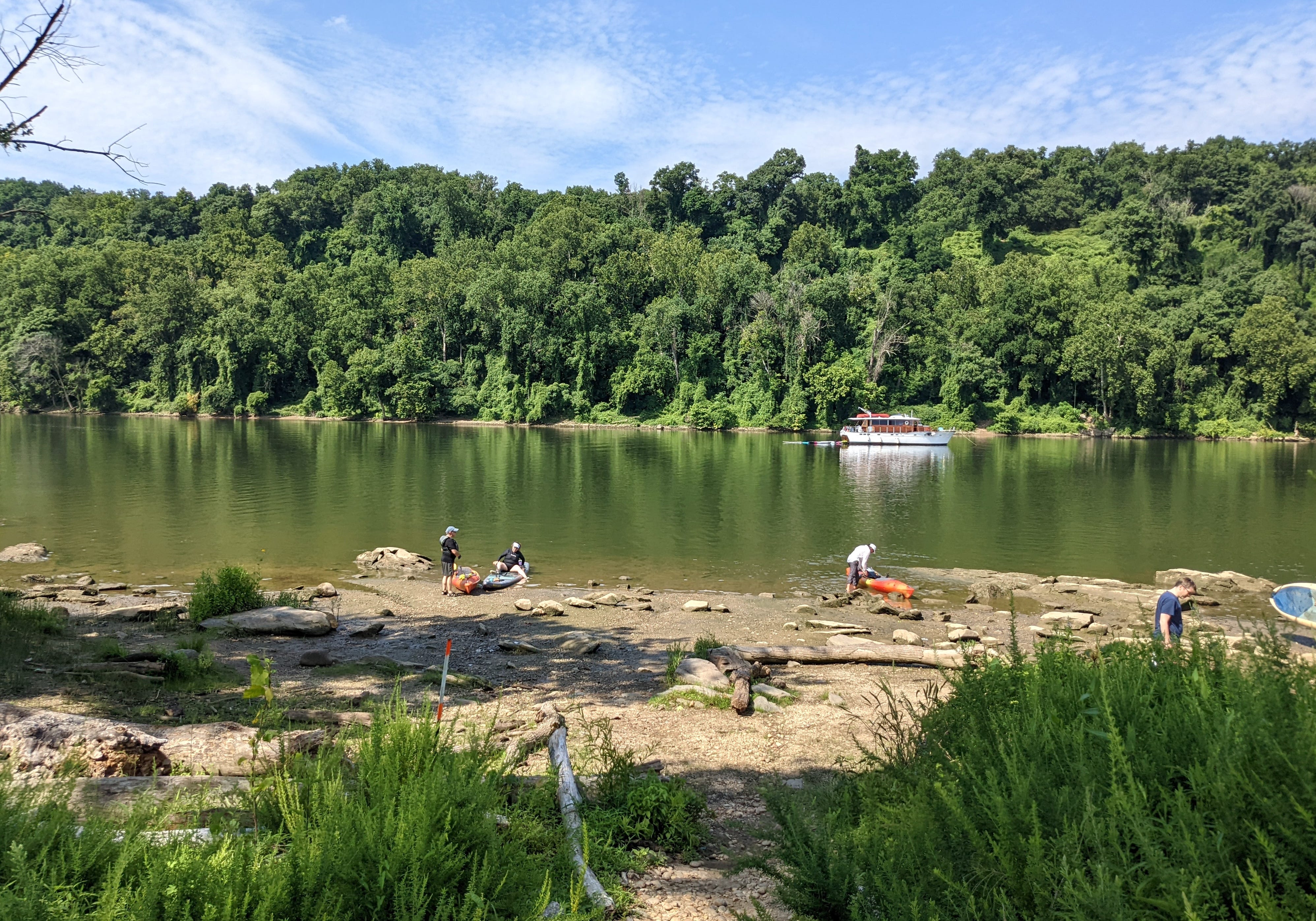
A public riverfront at Fletcher’s Cove park and recreation area, within walking distance of our longtime home in Washington, DC. At this site, managed by the National Park Service, boaters, picnickers, anglers, and even swimmers look across the Potomac River toward the Virginia shore. (Photo James Fallows)
The purpose of this post is to say something about Washington, D.C. as a real place. Rather than as the political prop most recently weaponized by Donald Trump, in his ongoing effort to change the topic away from Jeffrey Epstein.
Donald Trump obviously does not know this city. According to press accounts, and to judge by his own rhetoric, Trump lurched into declaring a “public safety emergency” for DC based mainly on two pieces of evidence. One was the reported injury of the 19-year-old former Doge staffer Edward Coristine, generally known as “Big Balls,” in an alleged carjacking. The other was Trump’s alarm at seeing a homeless encampment while being driven from the White House to his own golf course in Northern Virginia.1
Most news reports have properly emphasized that Trump’s claim of a new crime wave in DC is the exact opposite of the truth. Crime has been going down, not up; and it is lower in DC than in at least a dozen other major US cities.
But many reports have also cut Trump some slack, by saying that it “feels like” DC is becoming more dangerous. Of course any crime is too much crime, any homeless encampment represents failures on many levels, and any encounter with a menacing person is alarming.
But let’s take a bigger and longer-term perspective on what it feels like in DC. A “feels” report is by definition subjective, and this one has all the limits of my personal experience. But that experience goes back a long way.
DC as a place.
Everyone knows “about” Washington DC. It’s our nation’s capital, at certain times the world’s. Busloads and plane-loads of touring students are always arriving from around the country. Many American families, plus visitors from countless other countries, have come to see the Mall, the Lincoln Memorial or Washington Monument, the Zoo with its pandas, the Smithsonian museums, the White House, the cherry blossoms, and the many other attractions.
By this point I feel as if I know DC, as opposed to knowing “about” it. Even more details in a note below2, but some reasons:
My wife and I have been homeowners in DC nonstop for 48 years, since we moved there at the start of Jimmy Carter’s administration. (Though we have lived other places and rented out our house while gone.) I’ve worked in offices at six different DC locations, including both the Watergate building and 1600 Pennsylvania Avenue NW. We’ve paid federal and local income taxes, and property taxes, in DC for 48 years straight. Starting with Walter Washington and going through the current mayor Muriel Bowser, we’ve lived in DC through either seven or eight mayoral administrations—depending on how you count Marion Barry’s two separated terms.
Both of our sons were born in DC, and started elementary school there, and finished high school in the area. Deb and I are called for jury duty, like clockwork, every two years. She’s served as an actual juror in a criminal trial once; I’ve done so three times, including one with multi-day deliberations on a jury whose members ranged from a welfare recipient to a university professor.
We go to parades and civic events, inaugurations and celebrations and funerals. We hold DC public library cards. We have long-term connections with cherished friends and neighbors, many of whom have arrived in DC from someplace else.3 We’ve lived through week-long power outages, after DC’s notorious summer thunderstorms and derechos, and occasional winter blizzards. Twice we’ve been there during 17-year cicada emergences. We’ve been the object of DC urban crime, including when some amateur thieves got into our garage and tried to steal our car—but couldn’t, because it was a stick-shift.
What have we learned and seen over those years?
DC is one of the American urban-success stories of recent decades.
Anyone in DC can tell you that it has big problems. My experience is that the same is true of anyone in Shanghai about their home city, anyone in LA about LA, any Londoner about London, anyone anywhere about the place they live.
But if you can find anybody who knew the area in the 1970s, the 1980s, or even the 1990s, and does not think that the DC of 2025 is vastly more pleasant, more stimulating, more beautiful, more environmentally sustainable, more cultured, better managed, and safer than it was a generation ago, then you have found someone detached from reality.
(This is not even to talk about the late 1960s, when riots in the wake of Martin Luther King Jr’s assassination left large parts of central DC in flames and more than 18,000 federal troops taking control of the streets.)
A few numbers-and-texture illustrations:
-DC’s population had been falling from 1950 to 2000. It has been growing since then. Which creates its own problems, but I’ll get to that.
-The Potomac River was a literal sewer when we first moved to DC. Through a decades-long effort it has been cleaned up; fish and wildlife have returned; and it’s a vital center of boating, fishing, and recreation. Even dolphins have returned to the river! Even swimmers are out there! (Including Deb.) Bikers, walkers, runners, and hikers use trails that didn’t exist when we came here. The city’s natural endowments are attractions rather than eyesores or embarrassments.
-The DC we first knew had half its downtown streets closed or under construction for the Metro. Now the Metro system, like all mass transit everywhere, has its challenges. But it has become an indispensable artery of residential, commercial, and cultural connection through the area.
-You name an amenity that makes for attractive public life, and on nearly all of them DC is better off than it was even a generation ago, and radically better than in the 1970s. Its universities have expanded and improved. (Georgetown, Howard, George Washington, American University, UDC, Catholic, Trinity, and Gallaudet are some on that list.) Its schools—public, charter, and private—are overall better.
The National Cathedral is even more beautiful than ever, including through reconstruction after the surprise earthquake of 2011. Every public park I’m aware of, in every diverse part of town, is in better shape than a generation ago. Schools have been renovated, including the public elementary school our sons attended. Playgrounds, recreation sites, and public swimming pools too. The Mall has phenomenal museums—all of them free. Historic buildings across the city have been restored—for instance, the abandoned Franklin School, in downtown DC, is now the Planet Word museum.4 A whole new residential, entertainment, commercial, and sporting area known as The Wharf has come into existence. Years before that, the Georgetown waterfront was changed from a dump site to a vibrant civic space. DC services, from tax-payment to trash-collection to pothole repair to tree-planting to the DMV, work much better than they used to. I could go on.
-And again, as you have heard from everyone outside MAGA, its crime rates have been going down. Here is a table from the US Attorney for DC—issued, as it happens, before Pam Bondi and Jeanine Pirro took over. The figures below apply to DC itself, and they show that the District has just had its lowest violent crime rate in 30 years.
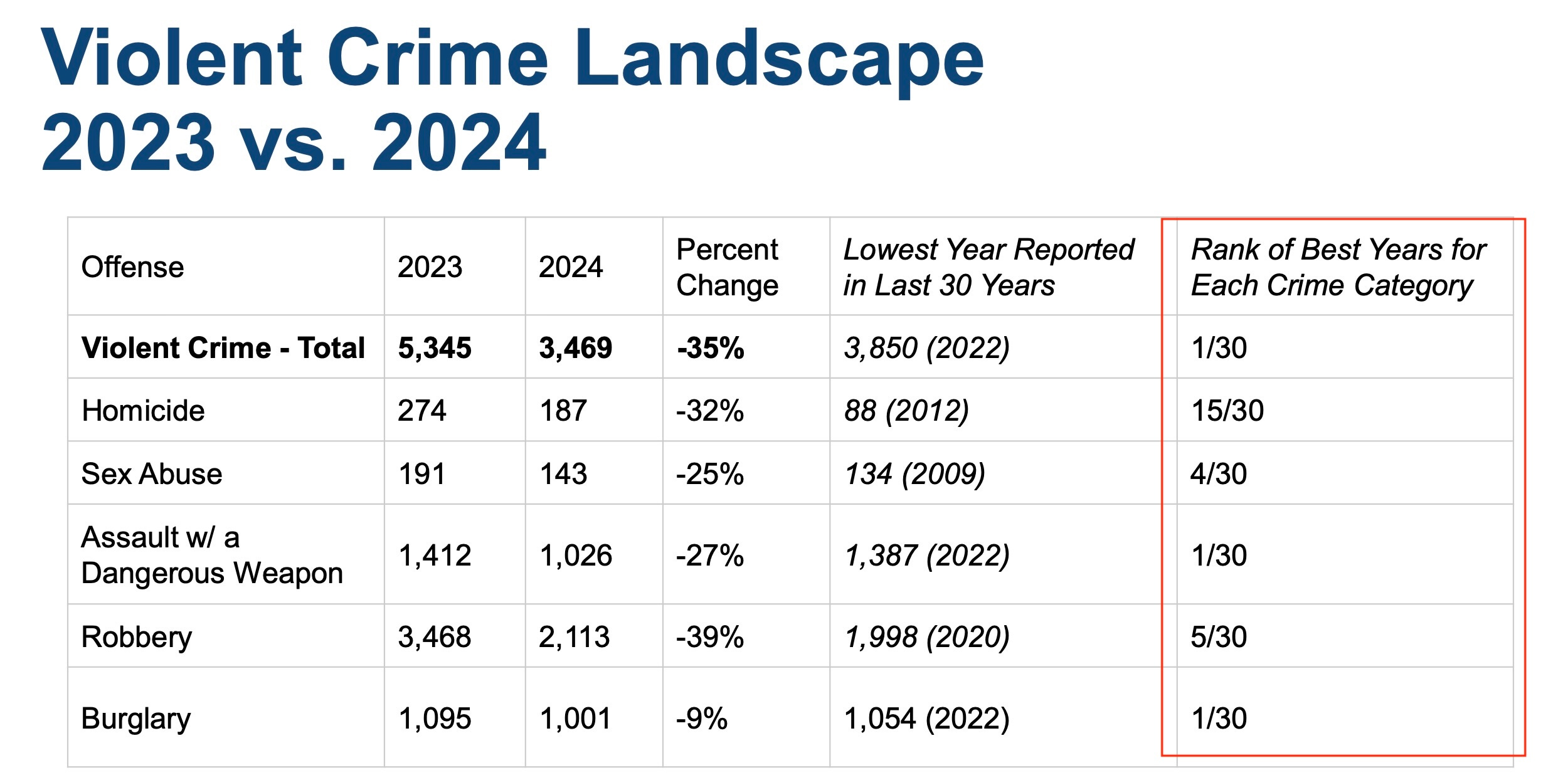
One more time, for the record: Any crime is too much crime. And the District, like other American cities, has countless failings, inequalities, areas of corruption, violence, and unmet needs. But overall and over time, DC’s situation has been getting better, not worse.
One of DC’s big problems is the other side of its success.
Even before the damage wreaked on its downtown office-and-retail economy by Covid, and then to the whole region’s business and institutional life by Doge and MAGA, a central civic issue for DC has been the dislocation and “gentrification” caused precisely by its revived urban and professional-class growth.
Keep reading with a 7-day free trial
Subscribe to Breaking the News to keep reading this post and get 7 days of free access to the full post archives.